Manifesto of 21st Century Communists
October 01, 2026
Rudolf Prikryl
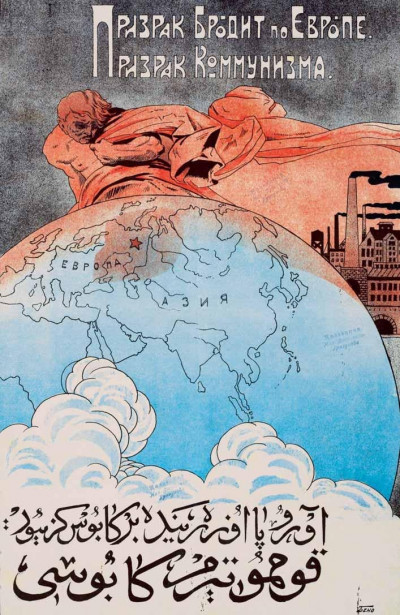
A spectre is haunting the world: the spectre of communism. All the powers of the old order have joined in a holy alliance to drive it out: the President at Mt. Rushmore and the President in the Kremlin, the palaces of the Gulf and the parliaments of Europe, the cable network and the hedge fund, the think tank and the masked men marching under the Confederate flag, the social democrats and the foundation-funded activists alike.
In 1848, when the Communist Manifesto was first written, the spectre haunted one continent, because that continent was then the whole of the capitalist market. The market grew until it covered the earth exactly as the first writers of that manifesto told it would. The spectre grew with it. Its writ now runs everywhere the wage is paid, which is everywhere. Wherever the market went, the attempt at exorcism followed it.
On Independence Day 2026 for the 250th anniversary of the US Revolution, the President of the United States stood beneath the carved faces at Mount Rushmore and announced that a communist menace is loose in the land: a mortal threat, he said, greater than the world wars, greater than Pearl Harbor, greater than the day the Twin Towers fell. “You can be loyal to Karl Marx, or you can be loyal to America,” he told the crowd, and swore before the fireworks that communism would be vanquished from American shores forever. It is the most honest accounting of the American condition a president has offered in 50 years not because open and avowed Communists are a real threat today, but because the fear of Communism still exists.
For where is the party of opposition that has not been called communist by those in power? A rent freeze is communism. National health services and insurance that every other rich country has had for two generations is communism. A twenty-nine-year-old social democratic lawyer who won a primary in Denver is communist. The mayor of the largest city in the hemisphere, elected to make the groceries cheaper, is communist. And where is the opposition that has not thrown the word onward? The President calls the Democrats communists, the Democrats, in the very week their insurgents won their primaries, declare that appeasement must end and their own socialists must be fought. And whom have they actually caught? Social democrats. City reformers. People asking for what Canada already has, not for the Soviet Union. The accusation rolls downhill through the whole of American politics, each party pressing the brand onto the one standing to its left, and the single point on which every party agrees is that the communist is always somebody else, always the evil boogeyman just around the corner.
And now turn the question around: where is the party in power that does not itself practice what it damns? The same President who swears to vanquish communism has taken the state into ownership of chipmakers and steel mills, opened a thousand-dollar account for every newborn in the country, leaned on the central bank to command the price of money, and stands ready — as every government of every state with a centralized banking system has stood ready, since at least 2008 — to buy the entire financial system the moment it fails again. From Washington to London, from Moscow to Johannesburg to Tokyo, the same play runs daily: damn the plan in the morning, create a plan by the afternoon. They call it emergency, stimulus, industrial policy, national security. This it is not communism, and it never was: it is the old order using the state as it has always used it. Losses socialized, winnings kept private in the hands of few, planning for the few. For the rest: the jungle of the “free” market, which is a jungle its own preachers take care never to live in.
Every bailout, every golden share, every market manipulation is a confession read into the record: that the “free” market cannot stand one winter on its own legs. The age of planning has already arrived and that the only question left open — the question this manifesto exists to force — is planning by whom, and for whom.
So let the communists speak for themselves, since every other entity in the country has been speaking for them. The working class is the class that does the work of this world and owns only a sliver of it: its warehouses and hospital wards, its classrooms and kitchens, its job sites and its desks. Communists are not the party of the center, which flees the name Communism. We are not the social democrats hunted under it, who never claimed Communism and disavowed it. We claim it. We are few, few enough, today, to fit in the beer halls where the first edition of the manifesto was commissioned. So were they, a small few. Our position is the same: that the old order is producing its own flood, and means to enjoy its estate until the water rushes through the gates of power. Our aim is the one no ruling power has ever forgiven: the working class raised to power, the debts of the household cancelled, the claims of the dead on the living struck down, the wars ended, health, home, learning, water, air and rest taken off the market, the earth repaired and the wealth that all of us made governed, at last, by all of us. We say this in daylight, under our own name.
Two things result from all of this.
First: Communism is admitted by every power on earth to be itself a power. And here nothing has changed since 1848. Nothing. When the first Manifesto was written, there was barely communism in Europe worth a police file. The pamphlet reached no one in time to build a single barricade. The kings and their ministers were not afraid of a little league of Communists. They were afraid of what they could read in their own ledgers: the price of bread, the wage books, the packed slums of their own capitals. They were afraid of what they themselves were making. The spectre, the fear, has always run ahead of the party of the workers. It is the ruling class’s knowledge of its own product, pushed outside itself and given an enemy’s name. The spectre is a mirror: in it the old order sees its own works, and calls the reflection an enemy. The President at the mountain was not describing his real enemy as all organized communists in his country could caucus in a single hotel ballroom. He was confessing his own output. The speech was a production forecast, read aloud, with fireworks.
Anticommunism is the last wage the order can still afford. To the worker whose town was gutted, whose pay has not truly risen in two generations, whose son came home broken from the empire’s wars, who was promised no new wars and got a new war, who was promised his country back and got the boot of the very order he voted against pressed into the back of his neck — to this man the regime offers one final payment: at least we aren’t communist. It is the wage of a graveyard. The loyal worker takes it, crushed beneath a boot, on a bed of medals stamped FELL FOR IT AGAIN. And mark whose phrase that is. The medal is not our invention, it is the reaction’s own propaganda: struck by its own internet pamphleteers to mock the very base they try to harvest. Even the swindler’s house journal admits the swindle.
Second: It is high time that communists should openly, in the face of the whole world, publish their views, their aims, their program, and meet this nursery tale of the spectre of communism with a manifesto of the party itself. And let no one mistake what that means. The fear of the ruling classes is true testimony about the work of their own hands. The first communists did not plead innocent, and they did not call the fear a fantasy. They signed their names to it. They took the rulers’ confession as a summons, and answered it first with the manifesto then with the party. We do the same. The fear has run ahead of the party once again. This manifesto is written to close the distance, to build the fighting thing the confession describes, until the ruling classes of the earth are once again afraid of something that exists.
I. Bourgeois and Proletarians
The history of all society up to now is the history of class struggles. Oppressor and oppressed have stood face to face in every age, carrying on a fight that ended every time, either in the revolutionary remaking of society at large or in the common ruin of the contending classes. In 2026 this is a measurement, kept in parts per million and degrees of temperature. Common ruin is no longer one branch: it is the default, the outcome that arrives on schedule if nothing intervenes. Every political question of our time is a question of which class will steer the passage of humanity through a gate that is already closing.
Read the first chapter of the old manifesto at a distance of a hundred and seventy-eight years, and the shock is how little of it needs rewriting. The world market it announced is the one we live in. Its “constant revolutionising of production, uninterrupted disturbance of all social conditions, everlasting uncertainty and agitation” is not a portrait of a Victorian mill town, it is this quarter’s earnings call. All that is solid melts into air. The bourgeoisie “has converted the physician, the lawyer, the priest, the poet, the man of science, into its paid wage labourers” a sentence that was an insult in 1848 and is a job posting now. It “has torn away from the family its sentimental veil, and has reduced the family relation to a mere money relation” priced today by the daycare bill and the two paychecks that no longer cover it. It “has concentrated property in a few hands” with the “poorer half” of humanity in 2025 owning just 2% of the world’s wealth, and of its capital, next to nothing. Capital, the Manifesto says, “is a social power,” and it has become one in the literal sense: pooled into funds, its title scattered across hundreds of millions of accounts, its management gathered into 20 firms that steer nearly half of the $140 trillion entrusted to the world’s asset managers, and where the pooling was done by states, the hands are fewer still. “The executive of the modern State is but a committee for managing the common affairs of the whole bourgeoisie” and we have only learned the new buildings the committee meets in, and it is the treasury and the central bank. And the crises still arrive as in the time of the manifesto with “the epidemic of over-production”: too much investment, too much commerce, and it is still resolved exactly as diagnosed: by destroying what was built and seizing new markets, “that is to say, by paving the way for more extensive and more destructive crises, and by diminishing the means whereby crises are prevented.”
And remember: in 1848 all of this was a portrait of the future painted in the present tense. The two great hostile camps were then a tendency. Most people alive — even in England — were neither factory owners nor factory hands. The intervening centuries were where it became real. Today nearly the whole human race lives by the wage or hungers beside it. The world aged into the manifesto.
The owning class, historically, has played the most revolutionary part. The old manifesto said so without blushing, and so do we. It has accomplished wonders far surpassing pyramids and cathedrals: it has wrapped the planet in fiber, put a computer in four billion pockets, read the code of life itself.
But the age that opened in 1848 has closed, and four things have changed enough to demand new text.
First, the world market is finished and is being torn apart by its own builders. The old manifesto watched capital batter down “all Chinese walls” with “the cheap prices of its commodities.” It could barely foresee the day when no walls were left to batter, no outside remained to absorb the surplus, and the great powers turned back to carving the finished market into armed camps. The tariff, the sanction, the export ban on the chip, the strait shut by missile fire. The price of oil, the master commodity, is no longer set by the market at all, but by states making political decisions with barrels. Competition between companies has fused back into competition between empires armed, this time, with hypersonic missiles and hydrogen bombs, on a planet already on fire. And inside the finished market, one move outweighs all the rest: the factories left. Forty years of offshoring carried the workshop of the world to another country, with a red flag and a party whose banner is emblazoned with the hammer and sickle. The money stayed in New York and the making did not and the financial system has no gauge for measuring the absence of the very thing it lives off.
Second, capital has fled from making things into holding claims on things. The signature property of our time is not the mill but the asset: the stock buyback, the bundled rent roll, the government bond, the company priced at a hundred years of profits that do not exist. Marx had a name for this: fictitious capital. A mortgage written against work not yet done, by workers not yet born, grown so vast that servicing it has become the main business of the state. “In bourgeois society, the past dominates the present.” Finance has perfected the arrangement: the dead hand now holds a lien on decades no one has lived yet. Every crash since 1987 has ended the same way: the losses moved onto the public’s books. Bailout for the top. Bankruptcy court for the bottom.
Third, the machine question has reached its final form. In 1848 the machine replaced the weaver’s arm and made the worker “an appendage of the machine.” In 2026 the machine drafts the contract, reads the X-ray, writes the code, sets the schedule, and grades the worker — badly, half the time, and it does not matter: the wage falls either way. And the general intellect, the inheritance of everything our species ever learned, has been fenced off as private property by half a dozen firms, the way the common fields were fenced off at capitalism’s birth. The professionals who believed their degrees were capital are learning they were always sellers of labor. A society that produces more with less work, under rules that pay income only for work, must deliver one of two things: shorter hours and freed lives or a class of landlords straddled on a people declared surplus. The relations of production have become fetters on the productive forces in the plainest sense ever achieved. The fetter is a license fee, a layoff, and a datacenter. Fourth, the crises have fused. The crashes of the nineteenth century came one at a time, each followed by recovery on a larger scale. The crises of the present come together: the military, financial, energy, climate, and political systems all draw on the same failing source, and when it moves they fail as one, at network speed. A war in one gulf reprices energy on every continent within the hour, that reprices the bond market, that reprices the state’s power to pay its own debts, that reprices its right to rule. “Modern bourgeois society... is like the sorcerer, who is no longer able to control the powers of the nether world whom he has called up by his spells.” The spells now run in microseconds, and the apprentice has automated the summoning.
And the working class? It did not vanish. The middle class was a postponement, bought on credit, and the credit is spent. The proletariat of 2026 is the warehouse picker whose pace is set by an algorithm, the nurse stretched across three patients too many, the coder laid off by the model he trained the teacher buying her own supplies for students, the driver who owns his car, his debt, and nothing else the graduate whose diploma is a lien on twenty years of wages, the laid-off manager discovering that nine years of salary bought him no property in his own future. Propertied on paper, dispossessed in fact: the house is the bank’s, the car is the lender’s, the degree is the servicer’s, the pension is the market’s, and the market is the platform’s. What this class demands, it demands concretely: care that does not bankrupt, rent that does not devour, an end to the wars, an end to a billionaire order that has become, for a whole generation, another word for theft. And of this class the old sentence holds, harder than ever: the modern worker, “instead of rising with the progress of industry, sinks deeper and deeper below the conditions of existence of his own class.” The ruling class “is unfit to rule because it is incompetent to assure an existence to its slave within his slavery.”
“What the bourgeoisie therefore produces, above all, are its own grave-diggers. Its fall and the victory of the proletariat are equally inevitable.”
Defeats and our increasingly burning sky have taught us how to read that sentence, and read rightly, it still stands. The fall is certain and it is underway. Victory is inevitable in every future that contains anyone at all. Either the working class remakes society, or there is common ruin, and in the ruin no one remains to ponder the prediction.
History has not crossed the old sentence out. It has narrowed it to a fork: victory, if humanity is to continue; nothing, if it is not.
And let one thing be said as plainly as it deserves, because the whole enduring power of the spectre lives inside it: communists do not make revolutions. The old order makes them. No club of radicals alone produced 1789. The palace produced it: the court that answered hunger with etiquette and calls for cake, whose own motto, coined in its own salons, was “after us, the flood.” No Bolshevik committee produced 1917. The Tsar produced it: the crown that answered a peaceful march of petitioning workers with rifle fire, that strangled its own parliament, that fed its peasants into the machine guns of a war it could not win and would not end. The bread lines of Petrograd pulled the throne down. The revolutionaries arrived afterward, bringing a name, an organization, a direction to the thing the regime had already built.
After me, the flood: it is not a threat, it is a prediction of their own undoing caused by their own hands. That is why the spectre is always accurate and always early. A ruling class that answers a demand for insulin with a lecture on markets, that answers a dying town with a tax cut for its creditors, that answers a burning planet with new drilling leases, that answers every crisis it causes with a bailout for itself and a foreclosure for everyone else: that class is the most productive revolutionary force in its society, and no committee of communists in history has ever matched it. Let them eat cake. Let them buy the dip. After us, the flood.
II. Proletarians and Communists
In what relation do the communists stand to the working class as a whole?
The communists are not a separate party set against the other parties of the working class. They have no interests apart from the interests of the class as a whole. They set up no special doctrines of their own by which to bend the movement. Most self-appointed vanguards of the class of the last hundred years recited those sentences while doing the opposite, so let them be given back their plain meaning. The communists are not the ninety-seven sects, each guarding its correct line like a saint’s fingerbone. Nor are they a secret elite. That party never existed, not even in Russia, where the iron machine of legend was in fact a quarrelsome faction inside a broad workers’ party, wrong at half the decisive moments, rescued again and again by masses who moved faster than its committees.
One thing, and one thing only, distinguishes the communists: at every stage of the struggle, they stand for the movement and the class as a whole. Today that means one exact operation. The old order manufactured the revolutionary situation and it is manufacturing one now but what it cannot manufacture is the direction. Right now the desire of the class takes the shape of requests to the existing state: pass the health care bill, freeze the rent, end the wars, tax the billionaires. The communists are the part of the movement — inside its organizations, never above them — who turn the request into a demand for power. Who say, at every step: the bill will not be passed, and if passed will not be enforced, and if enforced will be repealed, by anything except the organized power of the class itself. So build the organ that can enforce it and prepare that organ to govern. In 1917, Peace, Land, and Bread was the request. All Power to the Soviets was the conversion, the means to enact Peace, Land and Bread. The conversion is the whole of the communist program. Everything else is commentary.
The theory of the communists can still be summed up in a single sentence: abolition of private property of the means of production. And the old answers to the old slanders still stand. We do not mean your toothbrush, your garden, your house, your small shop. Finance has largely abolished those already, and forecloses on the remainder daily. In the existing order, private property “is already done away with for nine-tenths of the population” which was true in 1848, truer now. What we mean is capital’s property: the claim on the future.
The debt compounding against the household. The rent roll is bundled into an asset class. The patent on the addictive medicine. The AI model trained on stolen knowledge of everything humanity ever wrote, created, painted, rented back to humanity by the dollar. The barrel of oil whose burning is already priced into a child’s lungs. “In bourgeois society, the past dominates the present; in Communist society, the present dominates the past.” To abolish bourgeois property is to cancel the mortgage the dead hold on the living. Capital is a social power made by everyone, owned by a few. Making it common property does not turn property into no-property. It changes whom the power serves.
The first step remains what it was: “to raise the proletariat to the position of ruling class.” The working class will use its political power to take capital, step by step, from the owning class, and to run production through the working class organized as the ruling class, organized not through the substitution of the class, but through the organs the class builds in its own fight and holds as its own possession.
The measures will differ by country and by moment, and we lay no special stress on them. The old manifesto said the same, and its own authors called their ten points outdated within twenty-five years. But look first at what became of those ten: the progressive income tax. The national bank. Free public schools for every child. The tax on inheritance. Half the program of 1848 was enacted, piece by piece, by frightened reformers over the following century and is being repealed, piece by piece, by their heirs in this one. The other half still reads as sedition. A program, like a manifesto, is a bet on a timescale. For America in 2026, the following will be pretty generally applicable:
Universal public health care, removed from the market completely and forever. Not as the finish line, but as the wedge that teaches a whole people that life can be taken off the market, and that what congresses will not give, only their own organized power can take.
Housing taken off the market: the holdings of the corporate landlords and the vacancy speculators seized; rent control as a bridge; a public building program that makes the home a right instead of an asset.
Public ownership of finance: the central bank turned from the owners’ committee into a public utility. The giant banks nationalized in the next crash they cause, rather than rescued. Medical, student, and predatory household debt cancelled: a jubilee, written not as charity but as honest bookkeeping, because the claims were fiction from the start.
The energy transition, run as a public project under workers’ control: the oil companies’ unburnable reserves seized as the dead claims they already are. The grid, like the water system, held in common.
The general intellect brought home: the platforms, the AI models, and the computers they run on made public infrastructure. The knowledge of the species taken from all of us without payment or permission returned to all of us.
A tax on the capitalist order that destroys it, on wealth and on inheritance: an end to dynasties. The deportation machine abolished, and the border regime with it, as a tool of labor discipline. Full political and civil rights for every resident. “The working men have no country. We cannot take from them what they have not got.”
The war machine dismantled, withdrawal from the wars of empire. The arms industry converted to the work of the transition. Not one soldier, not one dollar, for the empire’s oil or the empire’s clients.
Free education from nursery to university, and the abolition of child poverty. Universal childcare: the school rebuilt as the first institution of the common wealth instead of the last unfunded one. All power to the organs of the class: the tenant union, the workplace committee, the strike council, the neighborhood assembly — built in struggle, federated in struggle, and prepared openly as the successor to the existing state.
When class distinctions have disappeared and production is run by the associated producers, public power will lose its political character for political power “is merely the organised power of one class for oppressing another.” Then, “in place of the old bourgeois society, with its classes and class antagonisms, we shall have an association, in which the free development of each is the condition for the free development of all” — an association that now inherits one duty the old manifesto never imagined: repairing the broken bond between humanity and the earth, which capital has torn perhaps past mending, and which no other class has any reason to repair at all.
III. Socialists and Communists of the Present Day
1. Reactionary Socialism.
When the old nobles of France and England were beaten by the money men, they took their revenge in pamphlets — singing lampoons on their new masters, whispering prophecies of doom. So the movement called America First half-mourns and half-mocks the order it serves. It curses the elites while staffing its government with them. It curses the wars while launching them. It promises the worker his country back and delivers him, bound, to the same banks, the same landlords, the same insurers, the same foreign lobbies and pays him in the one coin that costs the treasury nothing: whatever we do to you, at least it isn’t communism. So the aristocracy of our day, like the aristocracy of 1848, “waved the proletarian alms-bag in front for a banner. But the people, so often as it joined them, saw on their hindquarters the old feudal coats of arms, and deserted with loud and irreverent laughter.”
Some desert laughing. Some lie down under the boot and collect another medal — a medal struck, remember, by the reaction’s own printers, its inside joke against the people it bleeds. And note what this literature blames the ruling order for. Never that it creates a working class, only that it creates a rebellious one. And so, when the moment comes, it “joins in all coercive measures against the working class,” exactly as its ancestors did.
At the armed edge of this group marches its pageant: a few hundred masked men in matching khakis, carrying the Confederate flag through the capital on the republic’s two hundred fiftieth birthday, chanting about taking the country back. They are small. The liberals mock them, the senators call them a false flag. But 1923 was small. The national socialism is what the people’s desire becomes when no one turns it toward the future: end the pain, break the chains, name the enemy, and the enemy named is the immigrant, the communist, the Jew, the neighbor. The German road is not closed. It is being paved in daylight, on a federal holiday, with a police escort.
2. Conservative, or Bourgeois, Socialism.
“A part of the bourgeoisie is desirous of redressing social grievances, in order to secure the continued existence of bourgeois society.” To the old list — economists, philanthropists, improvers of the condition of the working class, organizers of charity, bourgeois socialists — our century adds the public-option architects, the abundance pundits, the ESG fund, the foundation officer, and the strategist who explains that voters want economic populism but must never receive anything that disturbs a single property relation. These so-called socialists want all the advantages of modern society without its struggles and dangers: “a bourgeoisie without a proletariat.” The vilest reactionary wing’s newest publications are a declaration of war on the meek conservative socialists inside the opposition party itself printed in the party’s own house paper, in the very week those conservative socialists won their primaries: no more appeasement, fight the “left.” Mark what that concedes. The party of absorption has stopped predicting that an insurgency will fade. That is the highest compliment the redressers of grievances know how to pay. Absorption of the working class is still the program across the board, McKinseyite centrist or “new left” DSAer: take the desire, hand back a public option, call it a revolution. And absorption, not the police, is still the most dangerous weapon aimed at the working class movement.
3. Critical-Utopian Socialism.
The Owens and Fouriers of the present day build their model villages in code: the basic income that pensions the class off instead of freeing it, the post-scarcity machine that will dissolve the property question so that no one has to fight the property holders, the network state, the charter city, the billionaire calmly optimizing the future of a species he declines to consult. Like their ancestors, they see the suffering clearly, find the class struggle distasteful, and appeal instead to society at large “by preference, to the ruling class” for once people understand the plan, how could they fail to adopt it? And exactly as in 1848, the sharper the real class struggle grows, the louder these dreamers denounce it as crude and divisive, holding up against the strike and the primary and the council their pocket blueprints of the New Jerusalem, available now by subscription on Substack.
4. The Sects.
To these three our century adds a fourth, which 1848 could not foresee, because it is built from the embalmed remains of 1917: the socialism of the perfectly correct line. It has kept the myth of the iron vanguard alive against a century of evidence, and treats the party form as a magic word that will summon the class into being. It mistakes the discipline that fifteen years of mass struggle forged for a constitution that seven people can write in an online forum. Its texts are liturgy. Its splits are its principal activity. Its function in the movement is to stand at the exits. The sects hold fast to the letter of their masters against the living development of the class which makes them the utopians of the revolutionary tradition itself. One paragraph is what they deserve.
IV. Position of the Communists in Relation to the Existing Opposition Movements
The communists fight for the immediate aims of the working class as it actually is, not as the sects wish it were. But in the movement of the present, they also represent and take care of the future of that movement. In 2026, the class in motion is found in the strike wave and the new unions, in the tenant organizations, in the crowds that met the deportation raids in the streets of Minneapolis and force them back, and whether the elect like it or not, in the electoral insurgency. The communists work inside these movements, as the first communists backed Chartists who were not communists and land reformers who were not even socialists. To fail to engage a sold-out union or election because its leaders are compromised is to hand the workers inside it over to those leaders. To engage these things without political independence, without a formation of the working class is worse, because you become the compromised leaders.
But the communists “never cease, for a single instant,” to teach the working class the plain and open hostility between the classes. The old manifesto gave one standing order: in every movement, bring to the front, as the leading question, “the property question.” We amend the order by a single degree, because a hundred and seventy-eight years have shown where the property question gets settled: bring to the front, in every movement, the power question itself.
Not only what to demand of the state but what organ of the class will exist to enforce the demand when the state refuses, breaks its own law, or cancels its own elections. A seat in Congress is a megaphone for the movement, or it is a hostage. A primary is a recruiting station for the organs of working class power, or it is absorption working as designed. Support the reform the way a rope supports a hanged man and build, in every campaign and every strike, the thing that remains when the ballots are counted: the committee, the council, the federation. That, and not the office won, is the real accumulation.
The old manifesto turned its eyes chiefly on Germany, “on the eve of a bourgeois revolution” and was wrong about Germany within the year. We nail that warning to our own door, and turn our eyes chiefly on America: because the world market is commanded from here, because the crises are fusing here, and because the ruling class of this country has taken up, more nakedly than any since the Bourbons and the Romanovs, the watchword “after us, the flood” and a ruling class with that watchword manufactures its own revolution.
The work of the communists, between this current anniversary of the United States and the old manifesto’s own two hundredth year in 2048, is to make the conversion of power before the ruin of the contending classes.
And on the “great adversary” of the United States, China, the communists must speak with the same refusal to hide anything, because it is the question the whole world is turning on now, and every power in the holy alliance needs it answered with untruth. To the President at Rushmore, Beijing is the communism to be vanquished. To the consultants of his loyal opposition, it is a rival to be out-competed back to sleep.
Both need it to be fraud or menace, because to read it as what it structurally is, the new productive center of the finished world market, built across seventy-six years via the industrial core outsourcing its own factories, put under a party that claims to have never given up the commanding heights, would put the US architecture on trial. The communists read it without those needs, and see what the rulers cannot: the siege has turned inside out. For the first time since 1917, the project that, at bare minimum, is claiming to be flying the red flag is not the starved edge of the world economic system but its workshop.
And the communists see, too, the “tell”. The General Secretary of the Chinese Communist Party stood in the Great Hall of the People on the hundred and fifth birthday of their party and named the origin of the party exactly: Marxism, joined to the workers’ movement, Marxism, held up as the weapon for changing the world.
Every word of that founding formula is true, but the last time the formula walked on its own feet in China, when the workers of Jasic reached for a union of their own, and the students who had actually read Mao came south to stand beside them, the state broke the union, disappeared the students, and shut down the Marxist clubs at the very universities where Mao’s Selected Works still top the library lists. A party can discipline capitalists and still fear the working class.
So the test we apply to Beijing is the one its own doctrine invites: when the organs of the working class rise on their own, unbidden, are they taken as the living content of a transition, or buried beneath the party and the state as its rival? The spectre’s writ, we say, runs everywhere the wage is paid. It runs in Shenzhen, too, then.
“The Communists disdain to conceal their views and aims.” Let the President declare from Rushmore that no one can be loyal to Marx and to America. We answer: we are loyal to the working majority of America, against the order that has mortgaged it, drafted it, foreclosed on it, denied it medicine, strangled it and offered it, as final payment, the news that at least it is not communist. Let the ruling classes tremble not at the communists, who never built the flood and never have, but at the flood of their own making, and at the one force that proposes an ark with room for everyone. The workers have nothing to lose but their chains. They have a world to win. And, for the first time, a world to lose.
WORKING PEOPLE OF ALL COUNTRIES, UNITE!
Afterword
The first Manifesto was written in the weeks before the 1848 revolution failed. It reached the printer in February 1848 and by summer the workers’ rising in Paris had been shot down in the streets, and within four years the reaction had won everywhere. Marx and Engels never rewrote the manifesto. In prefaces added over forty years, they admitted that details had aged, that the ten measures “would, in many respects, be very differently worded today,” that the Paris Commune had proved the working class “cannot simply lay hold of the ready-made State machinery, and wield it for its own purposes.” They let the text stand, because the text had never been a prediction: it was a description of a process and the process outlived the defeat of every movement.
Understand what kind of manifesto it was, commissioned by a league of a few hundred exiles. It reached almost no one before the barricades went up in 1848, and built none of them, and after the defeat it went out of print and stayed out for nearly years. The world it described, a society split into two great classes: owners and workers, everyone else ground down into one or the other, did not fully exist in 1848. In that year most people even in the industrial heartland of England were neither. The manifesto’s audacity was to describe the future in the present tense. Its power is that history obliged: we live inside its description more completely than its authors ever did.
This rewriting is made under a heavier shadow: the original was written before one defeat. We write after several. The wave of 1917, the largest attempt in history to make the working class conscious of itself, rose, took a sixth of the earth, industrialized it, broke Hitler’s armies, and then hardened in isolation: a state partially above the class, a plan partially above the producers, until in 1991 it mostly dissolved.
The lesson of this defeat is not the one the winners printed. It is not that the process ended, it is that seizing the state is not the same as holding it: a revolution sealed inside a siege becomes a permanent garrison, and it is the garrison that becomes the state. The failure of 1991, like the failure of 1848, discredited a generation of forms but it did not repeal the contradiction that produced them. The proof stands before us, 35 years after the “end of history,” as the President of the United States declared communism today a greater threat than both world wars. No one digs up an enemy that is staying dead.