United Front with Whom? How the Tempest Collective Reimagines the United Front as Bourgeois Populism
September 08, 2026
Tibor Szamuely
I
Earlier this year, Aaron Amaral, a seemingly prominent member of the self-proclaimed revolutionary socialist organization, the Tempest Collective, saw fit to share what his organization considers to be the “united front approach”. Since variants of this “approach” are common currency with the opportunist left, regardless of whether they visualize themselves riding or ambushing a tank in Budapest in 1956, it is perhaps worth our while to dissect how Amaral characterizes it.
According to Amaral:
This article will focus broadly on “the Resistance” (the movements and constellation of forces that have grown up in opposition to the Trump administration and its authoritarian efforts), its political dynamics, and the role and posture of the revolutionary Left.
I start here because this new reality defines and delimits the nature of the class struggle in the United States.
Here, from the start, the class distinction between the labor movement as a site of contention between bourgeois and proletarian labor politics internal to the working class, and the polarization of bourgeois civil society under the pluralist-democratic form of bourgeois dictatorship between the party in opposition and the party in government, is effaced. There is no doubt that, within all such articulations of bourgeois dictatorship, this polarity “defines and delimits” the terrain of the class struggle as one of a multiplicity of external factors which shape the terrain of the confrontation. This is, in no way, an exceptional attribute of an alleged “state of emergency”, which Amaral implicitly attributes to Trump’s efforts to strengthen the executive. However, such dubious emergencies are often the last, or as in this case, the first refuge of scoundrels.
After this promising start, Amaral continues his compulsive blurring of class lines by declaring with regards to Trump:
Whatever its populist veneer, this is a government of and by the billionaires.
Although Trump’s tendency to staff his cabinets with other big capitalists, as opposed to the credentialed professionals who might be preferred by a bourgeois government of more staidly technocratic tastes, is no doubt noteworthy and deserves further analysis, this particularity in no way makes his administration a “government of...the billionaires”. Regardless of its sociological specifics, the Trump administration is, like all bourgeois governments, a government of the millionaires in their millions; precisely like the Biden administration, or any future DSA government in the tradition of Tsipras, Mitterrand or Palme. Whether this dictatorship of millionaire parasitism is to be exercised by a financial oligarch like Howard Lutnick, or a union organizer fired for their Palestine flag pin, is as tactically significant as it is strategically secondary.
Amaral now seeks to contextualize this “billionaire government” in the dynamics of our historical period:
All of this needs to be placed in the broader crisis of late neoliberalism. For capital, the challenges of re-establishing systemic profitability in a global system marked by sluggish growth, at best, and built on unsustainable and contradictory fiscal and monetary policy, has provided an opening to the far right.
In the above, we are immediately confronted by the ambiguous, fence-sitting phrase; “far right”. This term is convenient for those who want to conjure the sense of ominous, looming threat required to justify any proposed jettisoning of essential class-principles without the heavy baggage of the notorious F-word; fascism. This is fortunate because today’s right, however “far” it may be, shares little in common with its interwar cousin. If fascism sought to destroy bourgeois democracy in order to save bourgeois property relations, today’s national conservative international seeks to mobilize the discontents of bourgeois democracy, so that the adventurers at its head can share the spoils of state power within the democratic framework itself. There are no substantial class vanguards to smash, no workers' state to roll back, only the opportunity presented to ragtag bands of political entrepreneurs by the self-inflicted decomposition of the bourgeois public sphere.
Regardless, according to Amaral, it is the offensive of this “far right” which sets the stage for an American political situation in which “…some of the most acute fights over the last few years, and therefore some of the biggest social movements, have been about basic democratic rights”, democratic rights which are “foundational class questions.” At this point, the premise of the Tempest effort to liquidate proletarian politics into the bourgeois-democratic camp becomes clearer. Democratic rights, however vital they indeed are for the proletariat to constitute itself and assert its power within the most favorable possible environment, are not, by definition, of specific interest to the proletariat in class terms. The proletariat shares its interest in democratic rights with all oppressed strata and all opposition parties regardless of class position.
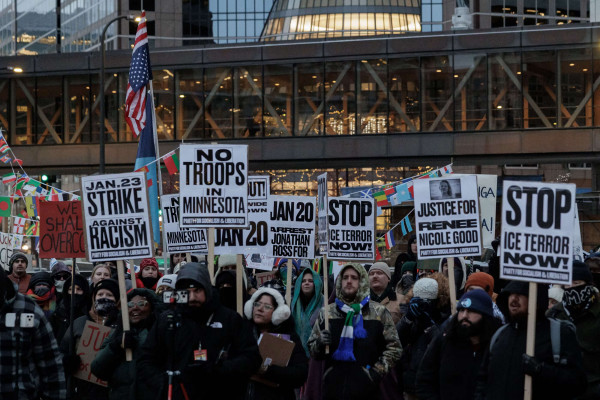
The “class questions” which are truly “foundational” are precisely those which differentiate the working class from the broad and situationally fluctuating democratic camp as a whole (a camp which incidentally has never completely or comfortably overlapped with the left wing of the Democratic Party base in the US, despite what activists of the Tempest type may choose to imagine) are those related to its specific class-situation. They are those related to its rights within the wage relation and against the capitalists, not to the rights of civil society as a whole. It is the particularity of struggles over “class questions” that – far from uniting civil society, as workers and business-owners were united in the sham general strike of Minneapolis – divide it.
This conflation of democracy and socialism is summed up in the organizational statement from Tempest itself, cited by Amaral, that:
We should understand struggles against identity-based oppression as struggles against capital’s socio-material relations…
Here, the influence of Social Reproduction Theory, as a hegemonic post facto theoretical justification for the practices of the Democratic Party-aligned social movement left, is apparent. In fact the exact opposite is true. Struggles against “identity-based oppression” are inherently waged both by those with an objective interest in strengthening and those with an objective interest in weakening “capital’s socio-material relations”. What the former have to gain from obscuring this is clear; why “revolutionary socialists” would play the same game – much less so.
At this point, having just eaten his cake by affirming that “struggles against identity-based oppression [are] struggles against capital’s socio-material relations”, Amaral rushes to vomit it back up on to his plate by insisting that:
Taken as a whole, the breadth and depth of these attacks and the struggles that follow, also mean that the Resistance has been likewise broad and cross-class...This has inevitably meant that the perspectives and strategies of the different parts of this broad, cross-class movement is being contested. Different parts of the movement reflect different politics and different class interests.
It cannot be had both ways. If democratic struggles are “...struggles against capital’s socio-material relations”, they cannot by definition be “broad and cross-class”, nor can different parts of the movement reflect “different class interests”. At this point, an attentive reader of our polemic can fairly object and point out that the immutable struggle of two class lines within the labor movement can be equated to Amaral’s characterization of democratic movements above. This comparison, as compelling as it might seem at first sight, is misguided. The labor movement does not have a broad, cross-class base, nor do different elements of the base of this movement have different class interests. The capitalist agents who operate within the labor movement, in the form of the bureaucracy, represent class interests alien to this movement’s own social base.
The democratic movements championed by Tempest on the other hand are constituted by the internal antagonism of such interests. If class-conscious workers oppose immigration restrictions and support full rights for migrant workers because it is a necessary precondition for the broadest possible unity and greatest possible power for their class, elements of the bourgeoisie oppose immigration restrictions because they limit access to cheap labor, and elements of the petty bourgeois want legal status as they exploit workers in their new countries of residence. Participants in the immigrant rights movement, like in democratic movements in general, are not united by a shared class position in the production process. This becomes glaringly clear when workers and employers march together in demonstrations for immigrant rights, or when a populist like Ocasio-Cortez attempts to square the circle of the cross-class movements whose contradictions she politically mediates in the interests of the bourgeoisie, by both calling for a drastic hike in the minimum wage, and bemoaning the possibility that Trump-mandated attacks on migrant workers will drive up labor costs.
It is indeed true that “revolutionaries must be present and fight for our approach as a distinct current.” in all democratic movements. But that presence must not be premised on an erroneous understanding of the class character of these movements, an understanding that conflates them with the workers’ movement itself. All workers share an objective, material interest in the legal capacity for armed self-defense against violent attacks on their movement and institutions. Do all participants in the movement to protect the right to bear arms in the US share this interest? Certainly not. Many of them would, in fact, be in the forefront of such attacks, if the occasion arrived. This constitutive, objectively grounded, and irreconcilable internal antagonism is characteristic of all democratic movements, not simply the one often smeared as reactionary by disoriented Democratic Party-aligned leftists. This is also precisely why women of the Second and Third Internationals refused to identify as “feminists”, not out of petty spite or deference to male authority, but because, unlike today’s gentrified left, they understood the class line is the one red line which can never be crossed.
II
And at the turn of the new year in the Twin Cities, the different perspectives and strategies played out, with efforts of the Left to consolidate workers’ assemblies and to continue to build more lasting infrastructure. At the same time, those sections of the resistance most closely aligned with the Democratic Party leadership (the mayor of Minneapolis, the Governor of Minnesota, the leadership of the police and sheriffs offices) sought to demobilize the movements, and prioritized stability and a return to an unsustainable status quo.
For Amaral, it’s simple; the contradiction within the democratic movement is simply between a left petty bourgeois democratic line which seeks to intransigently carry the fight for bourgeois right through to the finish, and a right which, more directly tied to the imperialist state, fears the destabilizing impact of such a struggle, despite its own opposition party status. This ignores the class character of bourgeois-democratic rights as a whole. Any program of liquidation of immigration restrictions which is not organically tied to a specific class program of imposition of workers’ control over wages, hiring and firing and all basic aspects of the wage relation, will only worsen the condition of the working class as a whole, even as it levels the playing field for its most oppressed segments. The similarity with the emancipation of women in the West is instructive. Women’s mass entry into the labor market, though a necessary precondition of the most basic personal freedom for half of the class, was not conjoined with an increase in class power for the class as a whole. Rather, it coincided with its historic defeat. The fullest extension of democratic rights does not automatically and immediately favor socialism. A workers’ program of immigrant rights is not simply for free movement of labor, it is also necessarily for the harshest possible restrictions on capital. No citizenship for all, without union authority over the labor market and capital controls.
Amaral further emphasizes his disregard for the particular class aspect of general democratic movements by observing that:
It is also important to note the role of the trade unions. This is especially true because it has been where the trade union forces are more advanced in organization and politics that they can have a more decisive role in giving political direction and shape to the local Resistance movements.
It is simply absurd for a supposed “revolutionary socialist” to say that it is “also important” to “note the role” of the only existing class organizations of workers qua workers, as if it were some kind of incidental afterthought. Any kind of worker line on broad democratic questions can only be articulated first and foremost via a struggle within the organizations of the class. In fact, Amaral would rather not wage this struggle at all. He notes only that:
the strategic and tactical conservatism of the union leaderships, and the depth of their historic ties to the Democratic Party coalition, will negatively impact their role in a local Resistance.
Nobody could easily determine, from such a weak tea formulation, that there is such a thing as, not just a “conservative leadership”, but a consolidated bureaucratic strata, a “golden ten thousand” of functionaries, making more than a hundred thousand, who have practically absconded with the workers’ collective property as if it were their own. These people are not simply “conservatives”, the overwhelming majority of our fellow workers are understandably conservative considering the times; these people are enemy agents.
The corrosive defeatism is reinforced when Amaral sets his sights on the horizon of, not a general strike which imposes specific class demands and raises the question of power, but one in the style of the KCTU’s strike against Yoon; i.e., a workers’ action for bourgeois-democratic normalization much in line with the kind of defensive action against Trump’s “fascism” visualized by David Van Deusen and others.
This outlook finds its immediate tactical expression when Amaral conjoins a condemnation of the neoliberal centrist Resistance organization Indivisible with an endorsement of its social-democratic twin May Day Strong:
May Day Strong was spearheaded by the Chicago Teachers’ Union. It has brought together unions, immigrant rights groups, other social movement organizations, and NGOs in a potential united front of working-class forces.
May Day Strong does include Indivisible and another liberal formation, 5051, and it is limited by the horizons of the left union bureaucracy. Nevertheless, it has taken an initial call by the UAW leadership, and helped put May Day back on the map, encouraged solidarity schools to prepare unions to stage political strikes against Trump, and pushed the slogan “no work, no school, no shopping” for this year’s May Day.1 And in Chicago, the CTU and its May Day coalition are campaigning for the mayor to shut down the schools, and therefore to shut down the city, in a backdoor mass strike.
May Day Strong is the key national vehicle to advance the argument for a general strike to challenge Trump’s increasingly authoritarian regime. Its explicit model is the South Korean strike that blocked a coup and toppled the government. That said, it is not immune from cooptation by the Democrats through the trade union officialdom’s alliance with the party. And it does not exist in all cities and towns.
In the above, we learn that NGOs, which are not democratic mass organizations of the working class, (or even cross-class democratic mass organizations) but simply groups of service-provision professionals, funded by the capitalists, with zero organic connection or structural accountability to any working class constituency, for some reason have a place in the workers’ united front. We also learn that May Day Strong, despite being framed as an alternative to Indivisible, in fact includes the latter formation. And finally, we learn that May Day Strong’s strategic vision and Amaral’s are identical, a KCTU-style strike, not for workers’ power and against the bourgeoisie, but for civic-democratic normalcy and against Trump’s so-far distinctly underwhelming power grab. Most amusingly, we learn of Ameral’s concern that an initiative of a Democratic Party bastion like the Chicago Teachers Union bureaucracy, with an aspirational program of striking against Trump – and thus unavoidably for the Democratic Party – might be “coopted”...by the Democrats! As is so often the case, willfully naive wish-fulfillment that reads like fanfiction is dressed up as “analysis”. The people who have indeed been “coopted” are the Amerals of the world.