Third World Delusion: Torkil Lauesen’s Tirade Against Sweden
June 23, 2026
Tibor Szamuely
It is the sad fate of Marxism, decomposing after decades of deep reaction, to be scavenged by the vultures of the democratic petty bourgeoisie. Feeling the need for “scientific” gravitas, they adorn their ahistorical moralism and utopian schemes with Marxist terminological garnish.
The work of Torkil Lauesen, a former participant in petty-bourgeois armed adventurism in his native Denmark, and now a prominent representative of the “third worldist” trend, is indicative in this regard.
I
Even on the more radical left, I have come across the view that the social democratic welfare state is a step towards socialism and that, “we can go with the Social Democrats halfway to our goal.” Such views are manifestations of a lack of a global perspective.
Even abstracting Sweden as a national social formation from the global structure which constitutes it, such a statement would be fundamentally incorrect from a Marxist perspective. The social-democratic objective was to pacify and integrate the working-class movement through the recognition of certain of its conquests within capitalist society in order to defuse any further movement towards socialism. Specifically, the next step embodied by the October Revolution and the particular articulation of the class relation it produced. Therefore, regardless of any negative externalities of the Swedish model on the global scale, it constituted an attack on the material interests of the Swedish workers themselves. Because, regardless of the severity of any initial sacrifices, the economic security and freedom ensured over the long-term by the expropriation of the Swedish capitalists and the initiation of transition towards socialism would have been qualitatively greater for the working people of Sweden than the inherently temporary and limited gain embodied by the Swedish model, whose condition was the repudiation of any aspiration towards the liquidation of the capitalist class.
To require a “global perspective”, of the type implied here, to understand the class-alien character of the Swedish model, reduces the question of socialism to that of a relative quantitative increase in the wage within the framework of bourgeois relations of production, which along with the continuation of their political manifestation, are taken as a given. The Swedish model cannot be understood as an assault on the working class first and foremost within the borders of Sweden, because socialism is reduced from a qualitative transformation of the capitalist relations of production to a quantitative question of redistribution within these relations. This is precisely the kind of vulgar petty-bourgeois socialism which Marx and Engels spent their lives combating in the person of such representatives as Proudhon and Duhring. As noted above, such a qualitative transformation has a tangibly superior quantitative impact on the security and freedom of working people. Only from a trade unionist, economistic perspective is the “global perspective” of the type advocated by Lauesen required for a fundamental critique of the Swedish model. Therefore, at the beginning of the text he already gives up the game. Like the third worldist tradition in general, his concept of socialism is a vulgar redistributionist one closer to Kohler’s “global Keynesianism” than anything in the works of Marx and Engels.
He goes on to observe that this “global perspective” is necessary because “we are not struggling for the specific benefit of the citizens of privileged nations like Sweden, but for the proletariat regardless of national or ethnic background.” This wording already already implicitly clarifies another two structuring principles of his standpoint – citizens of nation-states like Sweden are identified first and foremost as such and not as members of an illusory community divided into antagonistic classes, and the “specific benefit” of these “citizens” runs counter to the “benefit” due to the proletariat in general. If communists understand that the community of interests among citizens asserted by the bourgeois national state is an ideological fraud of the dominant class, whose exposure is a precondition of proletarian class (as opposed to petty-bourgeois trade unionist) consciousness, third world redistributionists like Lauesen take it as a fact which forms the point of departure for their analysis.
Lauesen next begins his historical overview by asserting that “the rise of capitalism in Europe and colonialism are two inseparable phenomena.” This statement is wrong in a manner just as indicative of the author’s incomprehension of the qualitative differences between modes of production as his observations on the “global perspective” examined above.
Although capitalist development in Europe and European colonial exploitation are incidentally entwined, and, as Lauesen correctly observes, the latter “boosts” the former, they can only be understood as separable phenomena. Not only was colonial exploitation distinctly non-capitalist in character, relying upon forms of surplus extraction characteristic of the feudal and slave modes of production, but the mere absorption of surplus from this exploitation was in no way sufficient to secure the development of capitalist production. The clearest proof of this is immediately referenced in his own exposition when he details the role of the Spanish colonies in drastically increasing the means of exchange available to European economies. Spain, despite the immense wealth it extracted from colonial exploitation, itself remained a largely semi-feudal economy and failed to develop a predominance of capitalist production relations along the trajectory exemplified by England and the Netherlands. We can see from this simple fact alone that colonial exploitation is in no way sufficient to explain capitalist development in Europe and the qualitative transformation of productive forces this entailed, which (rather colonial exploitation) formed the main foundation for the unprecedented wealth of early capitalist societies.
Colonial exploitation was only the latest in a long series of episodes of conquest and plunder which, absent the development of specifically capitalist production based off the extraction of relative surplus value from free wage labor in some colonial powers, would have had no more lasting economic impact than the Arab or Mongol conquests. The petty-bourgeois democratic mythology that European wealth emerged merely from colonial plunder functions to obscure the specific feature of capitalist production as relative surplus value extraction premised off expanded reproduction, and therefore fundamentally different from prior modes of production, which reproduced their own conditions of production in a relative stasis. This mythology further provides the basis for a petty-bourgeois critique of capitalist wealth inequality and uneven development; one in which the actually existing capitalist order is castigated not for its own constitutive feature – the free exchange of equivalents between judicially equal subjects without extraeconomic force – but rather, for its alleged insufficiently bourgeois origins in plunder and slavery.
The exploitation of the wage laborer characterized by a humanitarian and philanthropic respect for her sacred rights as a citizen and a human being – rights that make her in every respect the abstract equal of her exploiter – which is the proper target of a Marxist critique is displaced by petty-bourgeois platitudes about the “unfairness” of violence and robbery, with which Bastiat or any Austrian School gold hoarder could happily agree.
Lauesen, for his part, is much less interested in the development of specifically capitalist production relations in the Swedish iron industry than in the presumably shocking fact that the “chains and bars” on Danish slave ships were made of “Swedish iron.” No doubt, contemporary Swedes should be deprived of herring as a punishment for this horrible crime much as Algerians should lose their couscous rights considering the depredations of the Barbary pirates!
After this promising start, in a subsection entitled “Imperialism without Colonialism”, (Lauesen, like his cothinkers, tends to apply the term “imperialism” in its colloquial, not its Leninist sense, despite their frequent ritual appeals to the authority of Lenin’s writings) Lauesen seems to find something sinister and “imperialist” in Sweden’s 18th century participation in the tea trade with Qing China. The nefarious, “imperialist” character of this commercial interaction with a power that, at the time, far outclassed Sweden and probably could have conquered it absent some strokes of geographic good fortune, is apparently so evident that no clarification is required. However, for readers less inclined to see an aura of evil over every activity of the “white man”, what is implied here remains mysterious.
Not only does Lauesen substitute a moralistic condemnation of non-capitalist modes of exploitation for an analysis of capitalist development in Sweden, his moralism reaches such a pitch of hysteria that it contradicts itself. Swedish wealth, whether it comes from subjecting its tribal neighbors to forced labor or from free exchange with a more powerful state, is “imperialist” and, by implication, ill-gotten. We can only assume from this bizarre fixation that, for the “Marxist” Lauesen, if the Swedish bourgeoisie had restricted itself to the ruthless exploitation of free Swedish workers deprived of means of production by the inexorable and bloodless operations of the laws of competition against agricultural smallholdings, abstaining even from “consensual trade” with “colored people” and the “indigenous”, it could have preserved its moral rectitude.
Soon after, he admits that, just as the title of his book states. “In general, the Scandinavian countries did not have the necessary military power and administrative capacity to establish and operate their own colonies. They had to ride the wave of the great colonial powers in order to enjoy the benefits offered by imperialism.”
With similar “logic”, one could argue that, although Ethiopia itself lacked the “necessary military power and administrative capacity” to participate in the scramble for Africa, it was able to “enjoy the benefits offered by imperialism” thanks to its import of Maria Theresa dollars and manufactured goods from Europe. This would of course be an asinine line of thinking but one not essentially different from Lauesen’s. Indeed, if paying 18th century China in precious metal for a breakfast beverage is “imperialism”, there is no reason that similar purchases of European goods by Ethiopian merchants can’t fall into the same vacuous category. And more seriously, what essentially differentiates the future fate of the Nordic countries from their less fortunate fellow non-participants in colonialism such as Ethiopia, is not any more favorable terms of trade, but the ability of the former to develop specifically capitalist production based off the extraction of relative surplus value from free wage labor at a relatively early date, while the latter remained mired in feudal stagnation, not on account of “national character” but because of a different dynamic of development of the balance of class forces in the states concerned.
Unsurprisingly Lauesen himself shortly notes Swedish commercial capital’s early “complicity” in colonialism had little impact on the living condition of the population. In fact:
Sweden was a poor country in the early 19th century. The high standard of living and level of equality that would come later had no precedent in Swedish peasant society. Poverty in the Swedish countryside gave way to regular famines in the years 1867–69, when first cold weather and then drought made the crops fail.
II
We approach closer to the heart of the matter when Lauesen observes that “In the 1890s, Sweden underwent rapid industrialization, which led to a rise in wages in the mining, iron, and timber industries, forestry, and agriculture.”
It was this process, not iron in Danish slave ships or tea purchases in China, which built the foundations for the position of the country as a center of accumulation which continues to this day. According to Lauesen:
The industrial breakthrough in Sweden was linked to the development of capitalism, specifically in Germany.
This laconic statement serves as the flimsy support for a long tangent as digressive as it is unoriginal on the crimes of, not only German colonialism, but European colonialism in general; a tangent in which any attempt to clarify to what extent the appropriation of surplus from African or Asian labor enabled by colonialism facilitated the Swedish industrial breakthrough is conspicuous by its absence. We learn only that the Swedish bourgeoisie approved of colonial barbarism and assimilated its ideology of racial supremacy. The indisputable fact that Swedish industrial wealth was first of all produced by the exploitation of the “racially superior” and not extracted from non-existent colonial possessions is passed over in silence. This evasive digression is continued in a section on Danish industrialization whose main purpose seems to be to implicate the Danish bourgeoisie in British imperialism, again discretely sidestepping the exploitation of the Danish workers without denying it.
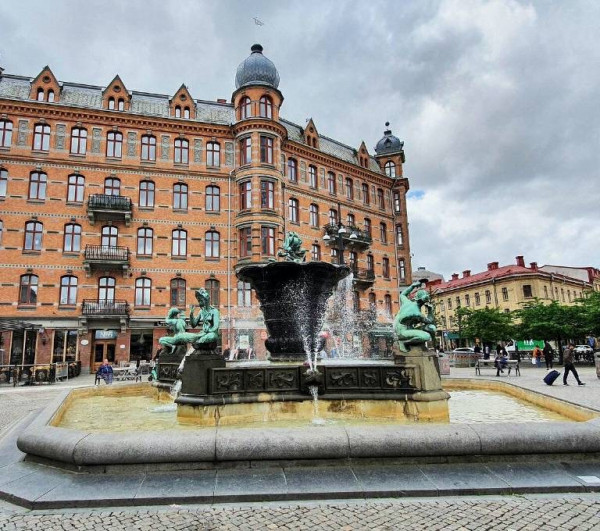
The best Lauesen can do is observe is that, in Gothenburg, a fountain was constructed in 1927 which allegorically represents the significance of the steel and iron industry as follows:
The official name of the fountain is The Five Continents. In the five corners of the fountain are statues of naked women who, by their ethnicity, are meant to symbolize the five continents of the world. From the center of the fountain, water springs from a bowl towards the women, just as Swedish iron flows out to the whole world, which responds gratefully by sending gifts back from the five continents, symbolized by water spraying back towards the center of the fountain. A symbol of Sweden’s integration into the imperialist world system… [emphasis ours]
The banal fact of the integration of the country within the world economy as a whole is taken as a sinister revelation of the “collective guilt” of its people regardless of class. Here we can see a pathological logic similar to the “memory culture” of the German Federal Republic’s state cult of philosemitic self-abasement. The complicity of the Nordic bourgeoisie with colonial barbarism becomes cause for morose “self-reflection” among the domestic victims of its exploitation, just as the National Socialist effort to exterminate the Jewish people becomes the responsibility of the German workers, themselves exterminated by the mercenaries of IG Farben and Krupps. In both cases, the blood libel is obscene. Those who consider such a claim hyperbolic should reflect on the political implication of positions which reduce the working class to a “perpetrator collective.”
At this point Lauesen begins to elaborate the full logic of his position:
The struggle of the proletariat for better living conditions and political rights combined with European colonialism and became the driving force in a new dynamic of capitalist accumulation on a global scale. Colonialism was a centrifugal force that propelled capitalism across the globe, at the same time as it was a polarizing force that divided the world into a core and a periphery. A periphery drained of value, which maintained the profit levels and a growing consumer market in the core. This dynamic solved capitalism’s inherent contradiction between the need to expand production and the lack of sufficient consumption power to realize a profit. In the second half of the 19th century, the proletariat’s living conditions began to improve in England. For the first time in the history of capitalism, capitalists had to pay a wage above subsistence level. This development spread from England to Germany and the rest of Northwestern Europe, including Sweden.
The one “missing piece”, which does not appear in this outline, which undergirds the other two, and to which we have already drawn the reader's attention, is the growth of the productive forces. It was the qualitative superiority of capitalist production proper (the production of relative surplus value) which enabled the bourgeoisie to both concede higher real wages to European workers while increasing the rate of exploitation of these same workers and to extract a rent from the pillage of backwards societies through the military superiority ensued by a superior organization of production. Lauesen recognizes every dynamic of the historical process except the one which, for Marxists, forms the foundation of all the others – the development of the forces of production. Thanks to this “fortunate” omission, we are left to conclude that the primary (perhaps only) factor in the capacity of the European bourgeoisie to moderate the class struggle through increasing real wages was the exploitation of the colonies. This is a reversal of the truth. The exploitation of the colonies was a supplement to the extraction of relative surplus value from the workers employed in European industry; a supplement which, whatever its undoubted political significance, was contingent and not essential within the structural dynamic of capitalist accumulation.
Probably Lauesen, recalling his early training in the neo-Narodnik “subjective sociology” of Chinese Stalinism, believes that the growth of productive forces is simply irrelevant in relation to the “omnipotence” of the class struggle, instead of grasping that the former conditions and determines the possibilities of the latter. At the same time, however, his notion of the class struggle seems limited to the most narrowly physiological interpretation of the “predominance” of the “economic factor.” Thus, we learn that because by the “turn of the century, widespread hunger—as we still see today in the Third World—had disappeared from Western Europe”, the “revolutionary part of the labor movement weakened.” Clearly, for Lauesen, revolutionary struggle cannot be a product of rising expectations for a better life, whose full realization being blocked by the outmoded relations of production, can only be fed and encouraged by increasing concessions intended to pacify them.
Contrast this with Plekhanov’s summary of the dynamic of the French Revolution:
The reforms the bourgeoisie were able to achieve, far from “blunting” the contradictions between its innovatory aspirations and the old social order, gave a fresh impetus to the growth of its forces, encouraged those aspirations still more and thereby aggravated these contradictions even more gradually preparing the social storm with the onset of which it was no longer a matter of reform but of revolution, not of changes within the old order but of its complete elimination.
Of course, Lauesen is unlikely to have read Plekhanov, because he sums up the world-historic process of emergence and growth of the Second International as the increasing “popularity” of “Reformist Social Democratic parties.” The fact that the Second International was formally committed to a program of socialist revolution, that it was the site of a bitter struggle against revisionism which culminated with the first successful socialist revolution in history, and then on the eve of the First World War, it pledged to combat imperialist war by revolutionary means, is simply denied, the facts be damned.
The reason for this courageous assault on the historical record is not hard to determine. For Lauesen and his cothinkers, the inherently non-revolutionary and indeed criminally culpable character of the working class in the “West” is the a priori absolute which justifies their desertion from the real field of battle (the internal life of the labor movement in their home countries) in favor of abstract “solidarity” with a “third world revolutionary movement” which today exists only in their fertile imaginations. Giving full weight to the “revolutionary aspirations” which have characterized the history of the “Western” labor movement would explode their self justification.
Indeed Lauesen is so committed to this that he casually substitutes Foucault’s concept of “biopower” for the Marxist theory of the state, insisting that the increasing intervention of the state in the wage relation necessitated by the imperative of containing the working class movement, far from illustrating the explosive potential of the class contradiction, only indicated that the “the state began to act on behalf of capitalist society as a whole.” Lauesen, like any right thinking cadre of the golden age of Nordic social democracy, imagines that the welfare state did in fact supersede the dictatorship of the bourgeoisie. A man who thinks that the “people’s home” was real and not mendacious propaganda sees fit to accuse the entire Second International of reformism.
Of course, he is quick to add that this “transformation had a negative consequence.” But this negative consequence is not, for Lauesen, the deepening slavery of the wage dependent to the irrational logic of private production for profit, which Marx saw as the inescapable trend of capitalist production regardless of any increase in the workers’ standard of living. On the contrary, this “consequence” is to be found in the alleged creation of a “unity between the citizens and nation-states of Northwestern Europe and North America—against the populations of their colonial empires”, because the “interests of the nation-state became the interests of the working class.”
In Lauesen’s mind, what was in the interests of the metropolitan working class was not the expropriation of the capitalists and the subordination of industry to planned production of use values, but a readiness to kill and die to defend the interests of “their” national-capital fraction, in the hope that relative advantage on the world market “trickles down” sooner or later in the form of better social legislation and higher wages. The idiotic lies of social-chauvinism are presented as fact. We are supposed to believe that the people enjoying the living conditions Jack London famously documented in London’s East End had more to gain from allowing British capitalists to export wheat from starving India than they did from overthrowing these same capitalists and turning production in Britain to the needs of British workers. Of course, a reader playing devil’s advocate can still wonder if, somehow or other, such a seemingly unreasonable proposition is true. But Lauesen, here as elsewhere in his shoddy mishmash, makes no attempt to prove it. Moral outrage over the crimes of colonialism does the hard and thankless work of papering over the gaping evidential holes in his diatribe. Much as with the reception of Goldhagen’s book Hitler’s Willing Executioners, what is most important is that the reader already have strong psychological motivations for believing in a lurid theory of collective guilt, with the rigor of the argument itself taking a backseat.
After the brief dismissal of “reformist” social democracy noted above, Lauesen moves into a review of the origins of the German welfare state which begins with the bizarre insinuation that German “colonial empire” was the foundation of, not only wage growth in Germany “from 1886 to 1911”, but also of the international significance of German Social Democracy. However much it may be exaggerated, the attribution of a determinate role to the possession of India in the relative standing of British imperialism no doubt has a strong kernel of truth, but to make the same claim for Namibia and Germany is downright audacious! As always, no evidence is provided for this seemingly self-evident chain of causation.
With the stage of “complicity” in colonial atrocity already set, Lauesen moves into the main body of his wholesale indictment of German social democracy. He begins by observing that the SPD played a “prominent role in the development of reformism in Europe.” As if it did not play an equally prominent role in the development of the revolutionary movement in Europe and the world. Without the legacy of the SPD, Bolshevism and by extension the communist movements in the colonial world which Lauesen commends, would not have been thinkable. All this is of small account in comparison to the “incriminating” fact that the SPD “found strong support among the upper strata of the German working class.” For Lauesen, the idea that relatively well-paid wage workers could object to the system of wage labor is hardly conceivable. After all, they don’t face “widespread hunger.” Why would they aspire to anything better?
The indictment continues with the unsourced assertion that Bernstein was the “leading ideologue” of the SPD. Though the truth of such a dubious assertion would provide powerful support to Lauesen’s claims about the character of the pre 1914 SPD, it is neither further clarified in the text nor backed by a single citation. What is noteworthy, however, even from the cursory review of Bernstein’s role and ideas provided by Lauesen, is the similarity of the latter to Lauesen’s own. In effect, Lauesen’s third worldism is a “radical” mirror image of the picture Bernstein already painted, of the happy integration of the “white” working classes, just as the critique of “one-dimensional man” was no more than a mirror image of bourgeois sociology’s purely notional reconciliation of the constitutive antagonism of the wage relation.
Lauesen’s hit job on the SPD has a complacent laziness which finds conformity to historical fact a matter of indifference. This is a sufficient indictment of the bankruptcy of his work and of the opportunist evasion of the real tasks of class struggle represented by his tendency.