How the Left Wing of the DSA Deludes Itself
October 15, 2026
Tibor Szamuely
Sob Story of a Political Scab:
Or How Democratic Socialists Rationalize Treason with Whining
At the end of May 2026, a member of the DSA’s Marxist Unity Group (MUG) caucus sat down in front of his keyboard with the mission of both justifying his and his comrades’ support for a bourgeois government, and at the same time, pouring out his heart to his readers, making clear at length just how conflicted this ever so adult and nuanced (not to mention strategic!) decision makes him and his partners in crime feel.
The title alone, “Sailing into the Storm”, conjures up an image of doomed mariners driven by inexorable fate to a tragic end. More emotionally sensitive readers may already be well on their way to tears before they recall that this particular fate (complicity in Mamdani’s regime of bourgeois dictatorship) was no bolt from the blue, but a product of the free choice of its “victims”. This particular victim, however, like any good dialectician, refrains from viewing his self imposed purgatory in unilateral terms, noting
Zohran Mamdani set a clear tone for his administration in his first 100 days in office. Centered on an earnest approach to basic fixes from bike lanes to potholes, his commitment to a better quality of life and government for everyday people is all too rare in American politics.
We are compelled to observe that, as pleasant as these empty formulations sound, they have nothing to do with socialism, which is why they could just as well have been penned by Chuck Schumer or Steve Bannon. Socialists are concerned with power for the working class, with the assertion of dominance by the working class over its enemies, with acts of force, with the seizure of the good things in life, and with inspiring appropriate fear and respect among the parasites and mercenaries who deny us these things. This partisan confidence and aggression is practically exterminated by the classless and conflict-free phraseology of the above. In this case, the form (a style worthy of a Beltway political consulting firm) corresponds perfectly with the content (the self-pity of political scabs).
After observing the light side of the Mamdani phenomena, our author now plunges into the darkness:
But Mamdani has also made a series of decisions ranging from confusing to legitimately disorganizing. He reinstituted winter homeless sweeps, endorsed right-wing Governor Kathy Hochul for her re-election bid, thanked “first responders” after the NYPD shot an unarmed man, and forced a DSA-backed candidate out of a congressional race in NY-10. At each turn, Zohran’s critics and cynics have cried “betrayal,” but the reality is far more complicated.
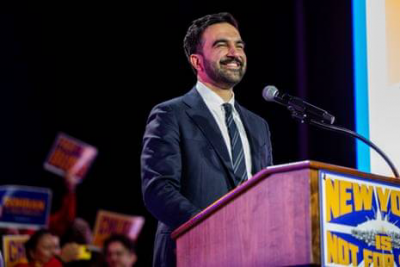
We agree completely that it is unfair to accuse Mamdani of betrayal. Like Sanders, Ocasio-Cortez, or any of the leaders of democratic socialism, Mamdani has been perfectly honest and forthright about what he is going to do, manage the bourgeois state in the interests of the bourgeoisie, while providing some token benefits to the working class, with which he hopes to build a governing majority; all while proving his fitness for power to Wall Street and Silicon Valley. Mamdani never lied about this during the campaign. He is not betraying his program, but fulfilling it. There is indeed a betrayal in this scenario, but not by Mamdani. The betrayal was the one carried out by the socialists with Marxist education who choose to deepen the historic demoralization and disorientation of our class by insisting, to the politically naive and uneducated, that this sellout program of kneeling and cringing before the millionaires like a castrated farm animal would be sufficient to change the balance of force between the classes in a manner substantive enough to restore some dignity to our lives. They made this choice to collaborate in a deception, not because it was the only option, but because it was the easy option. Building an independent political force with a revolutionary program is hard, superficially unrewarding work. Better to jump on the bandwagon of the collaborators and the traitors, because they have money, infrastructure, preexisting networks, and the impeccable advantage of a program in full conformity with bourgeois common sense. This is exactly the same course as all opportunistic and traitorous social democrats have taken for over 100 years, and is therefore completely unsurprising.
As Mayor of the largest city in the United States, Mamdani has taken on the burden of governance under a system that often treats municipal executives, and radicals in office more generally, rather poorly. Progressive mayors of American cities are dealt unplayable hands and then blamed for their inability to make effective change.
Only now do we understand the full depth of the tragedy! Not only are the poor DSA cadre victims of a situation that associates them involuntarily with “confusing” and “disorganizing” decisions. Mamdani himself is a victim of his status as a member of that newly discovered oppressed minority, the “municipal executives”. We can grasp the absurdity of this by taking Mamdani’s absurd pretensions of socialism seriously for a moment. What would a revolutionary socialist do if elected to executive office in a municipality? They would, as a matter of course, refuse the “burden of government” (on behalf of the bourgeoisie). They would use their position to agitate against the enemy state and disorganize it from the inside while providing all possible assistance to the workers’ organizations in their struggle against the enemy from outside. The “burden of governance” would be left where it belongs, in the gutter. Mamdani is taking on these “burdens”, not because he is compelled by some physical law, but because it is his program and that of the movement he represents.
Of course, a socialist Mamdani supporter would sagely respond that such a revolutionary socialist is hardly likely to win an election in the US at the moment, and would perhaps always have been a longshot at any time in the prior history of the country. We have no interest in disputing that point.
Revolutionary socialism was always a minoritarian position in the US labor movement even at its heroic height. However, it is revolutionary socialism that is the scientific method which transcends the contradictions of capitalist society. In the places where it won victory in the 20th century, it took major steps towards resolving these contradictions, despite its disadvantageous position and eventual defeat. The social-reformist “alternative medicine” of the Mamdanis, premised off the promise of a painless alleviation of these contradictions without tragedy and sacrifice, is a delusion, which alleged Marxists should have the sense to easily avoid. Indulging comfortable and popular delusions is not civic duty but irresponsible evasion of the harsh dictates of life.
By appeasing various elements of the capitalist state, Zohran has proven successful in legitimizing his administration. This is not inherently a problem, since compromise has been a law of politics since the dawn of government.
Nothing whatsoever, considered at such a broad level of generality, could possibly pose an “inherent problem”. However, for revolutionary socialists, “appeasing” the capitalists by governing on their behalf is not simply a problem, but a decisive indication that the actor in question is firmly situated within the enemy camp.
What I will argue, however, is that NYC-DSA leadership’s decision to back Zohran “to the hilt” without a hint of criticism, is leading us down a blind alley. Implementing Zohran’s “Affordability Agenda,” which has become the chapter’s immediate political program, is taking place in the back rooms and catacombs of the halls of power, outside of the view of the working masses and even our own members.
This revealing passage works effectively to elucidate the terms of debate within the spectrum of democratic socialism. The question is whether to back a bourgeois municipal government with complete and unconditional support or to serve as a dutiful loyal opposition. The very possibility of a non-collaborationist and independent position is inconceivable. Ironically, it is only such a position becoming grounded in the mass movement as a real alternative that could force a government like Mamdani’s to tack “left”. As it stands, figures like Mamdani find themselves “caught” between Wall Street and Silicon Valley on the one hand and the “looming threat” of sycophants and flunkies of the caliber of Eric Blanc and the MUG on the other. Whose concerns they will spend more time attempting to assuage is not in serious question.
Now our author takes a trip down memory lane recalling Wilhelm Liebknecht’s No Compromise pamphlet and drawing the conclusion that
In short, compromises with liberal and bourgeois parties become dangerous only when they obscure the class struggle basis of the party.
This is where the self-delusion of the DSA leftist reaches a delirious fever pitch. Liebknecht was writing as a leader of a socialist workers’ party with a revolutionary program that had established, through decades of struggle, a clear and sharp line against the liberal bourgeoisie (a struggle waged, not only by the Marxists, but the followers of Lassalle as well). MUG is writing as a faction of an activist group within a liberal bourgeois party that, far from even beginning to break from this party, is integrating ever more firmly within it. The class struggle base cannot be obscured by compromise because it simply does not exist. Liebknecht’s “class struggle basis” was constituted by decades of hard struggle to build an “iron wall” against all bourgeois parties which passed through the tempering of the Anti-Socialist law. And moreover, under the Prussian absolutist relic of feudal order, the bourgeois liberals, despite their deadly antagonism to the proletariat and their betrayal of the democratic camp, were not simply a status quo party – but a real, albeit limited, opposition.
In America in 2026, in a bourgeois democracy constituted on the basis of the full universalization of capitalist production and two world historic bourgeois revolutions, liberalism is not the opposition, it is the regime. A liberal today is not a Cadet, but one of the Black Hundreds; Black Hundreds who the DSA is not separating from in order to begin the necessarily long, brutal, and arduous process of building a “class struggle base”, but rather is fusing ever more closely into their core. German Social Democrats faced prison and exile to build the class struggle base which Liebknecht justly still feared for. Mamdani faces...friendly phone calls with Obama.
Despite practice often diverging from this ideal, NYC-DSA has weathered many bad votes, unexpected compromises with the Democratic Party, and a membership base that often demands more from our elected officials. But unlike our Assembly and Council interventions, NYC-DSA does not have a formal structure for engaging with the new reality of a DSA member in the Mayor’s office.
Translated from the diplomatic language of an opportunist micro-bureaucracy, we learn that despite its consistent betrayals of the more noble aspirations of its membership in service of the petty and sordid objectives of bourgeois political mercenaries, NYC-DSA has continued to rely on their reliable provision of free labor to fuel its schemes. But our author is worried that Mamdani might be the breaking point in this relationship unless members are placated with more subtle misdirection and manipulation than has hitherto been provided. We can only hope.
Our author is hopeful too. He ends his litany of complaints and worries on an upbeat note:
It is true that we cannot stay out of power forever. A strategy of permanent opposition has never succeeded in the United States, and workers grow tired of it just as quickly as they grow tired of mayors. But without tools to adapt to the reality we have created, we risk stagnation and the loss of our voice as the only truly independent force in American politics.
First, we must ask who is the “we” here? Not only does Mamdani govern on behalf of the bourgeoisie, the author has made it abundantly clear that Mamdani is confidently indifferent to the preferences of his aspiring hirelings in NYC-DSA. There is no “we” in power, there is only the bourgeoisie. Tisch’s comfortable job security is an amusingly crude illustration of this essential truth. So the statement is quite wrong, “we” can elect as many democratic socialists as we like to as many executive offices as we can imagine, and though “we” might obtain discounted bus passes and minimum wage hikes for our troubles “we” will remain safely out of power. Perhaps forever.
Secondly, we have to inquire as to the implications of the claim that a “strategy of permanent opposition has never succeeded in the United States”. This amounts to the truism that the socialist revolution has never succeeded in the United States, insofar as permanent opposition is the only strategically viable position for revolutionary socialists facing the bourgeois-democratic regime.
We have little doubt that most activists in MUG and others in the galaxy of “left” DSA caucuses, much like their more honest and straightforward partners in crime at Jacobin, in fact do not believe in the accumulation of forces for socialist revolution in the US, preferring to believe in a hallucinatory “peaceful transition”. However, they prefer obfuscation and mealy mouthed incoherence to a straightforward declaration of loyalty to bourgeois legality.
Finally we can only note that today there are no “truly independent” voices in American politics. Building one will mean decades of hard struggle. But the sooner begun, the sooner done.